Critical Areas Designation = Approved

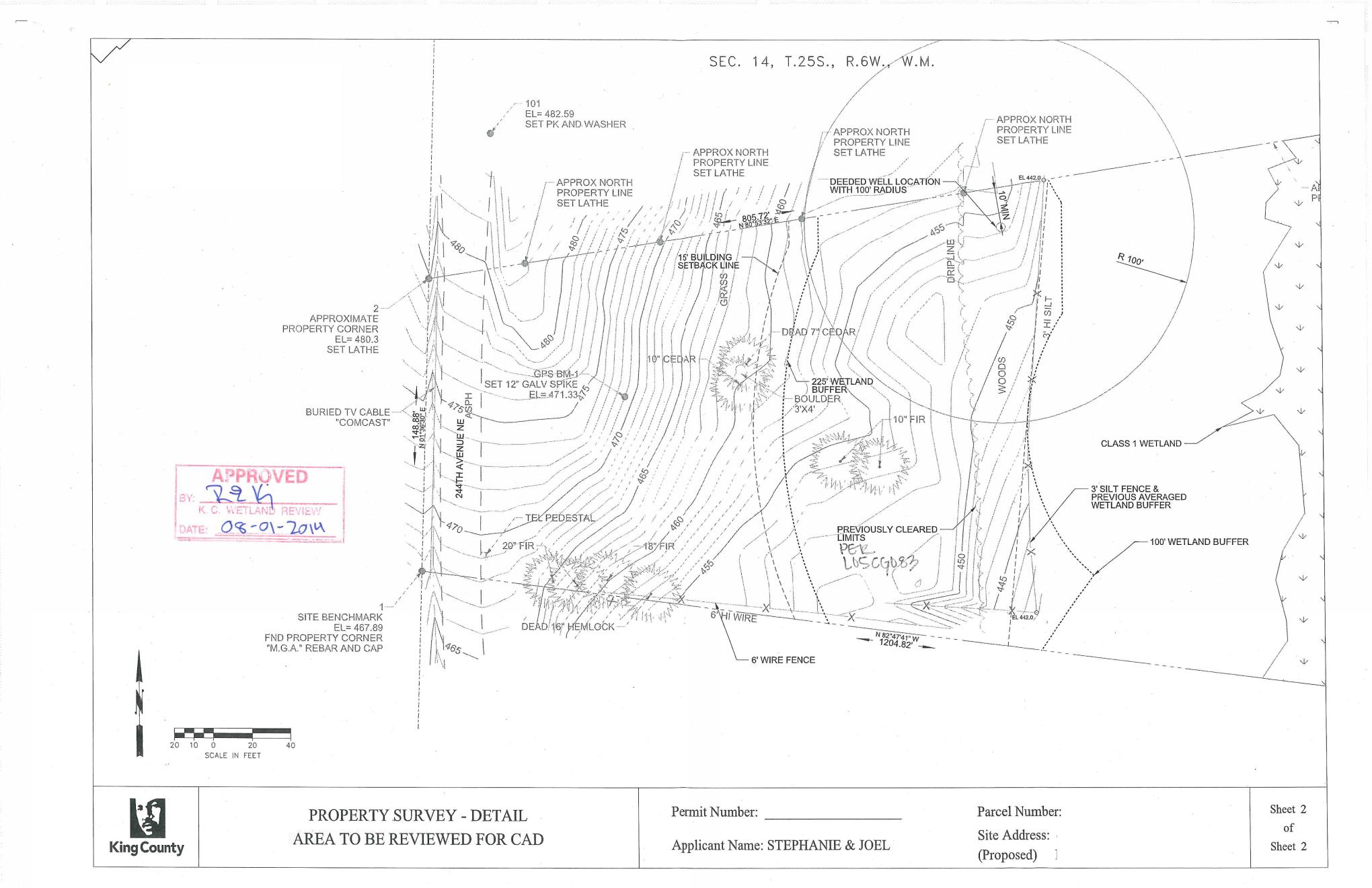
Nine weeks ago on May 29th we submitted our permit for King County’s Critical Areas Designation (CAD).  The County is so busy right now, that it was expected to take a while for them to even look at our application.  It actually sat for 9 weeks before someone was able to pick it up and take a look at it.  Our reviewer, Robert King, reviewed our application for completeness two days ago on Wednesday.  Then Thursday he did a site visit and today he approved it!  Nine weeks of the application sitting + 3 days’ worth of review = one approved CAD!

It really couldn’t have been easier for us.  But that’s because we did our homework up front.  I researched the heck out of our property.  This included requesting archived documents that the County had stored in their storage facility to be pulled – in there I found a wetland report that David Evans & Associates did a while back on the wetland for a neighboring property owner.  In addition, I hired Altmann Oliver (a wetland biological firm) to review the wetland in its current state and provide a letter of reconnaissance for the application as well.  When the County reviewed all of the documents that I sent, they said that our application seemed pretty straight forward and that the property had reputable consulting firms.  I guess it pays to hire people who the County trusts; otherwise who knows where we would have ended up.

So, what does this approval mean to us?  Well, it formally records the wetland + buffer with the County and if their regulations change (ie: buffer widths increase) it won’t affect us (at least not until the CAD approval expires in 5 years).  I also had a few questions about the 125’ of buffer space that was cleared in 2005 under an approved clearing & grading permit and if we were able to keep it as a backyard for the boys to run around in.  And guess what…the answer was yes!  Score!!

The next thing on the list to do is turn in our permit application to King County Health Department for our septic + well.  That has to be designed first…here we go again!

CAD Approval Letter 1

CAD Approval Letter 1

CAD Approval Letter 2

CAD Approval Letter 2

CAD Approval Letter 3
CAD Approval Letter 3

CAD Approval Letter 4

CAD Approval Letter 4

Before Design Can Begin

Before the design of our home can begin, there’s a few things that we need to take care of over the next couple of weeks.

  1. The first thing is getting an approved Critical Area Designation with King County. In short, because we have a wetland on our property we’ll need to have the wetland and buffer boundaries determined by a biologist. We need to determine how much land King County will allow us to use inside the wetland buffer area as a backyard. This really affects both our home placement on the property as well as the shape of the home. The more space we have as a backyard, the wider the depth of our home can be.
  2. We also need to get the property surveyed. Because our site isn’t flat, it’s important for us to understand the slope of the property. This will enable us to have a home designed that will work well and take full advantage of the contours of our property.

Although we’re excited to have Mike Blondino design our home, we really feel that having all of the necessary site information first will make the process go a lot smoother. Knowing everything we can about the site is sure to make for less revisions to the design in the future. After we get both the Critical Area Designation and the property surveyed, I think we’ll be all set to have Mike design our dream home!

Coasting to Closing

Finally on Tuesday we received the Open Space Continuance from escrow. It took escrow 7 days to fill out the form and get it back to us! Joel and I signed 4 copies of it for King County on Tuesday night and first thing in on Wednesday morning, our realtor, Lance, drove it to King County for their approval. And by Wednesday afternoon, King County had approved the continuance! I’ve heard that it normally takes a few days for King County to review the continuance, do the necessary research, and finally approve it. We were very lucky that it only took a few hours and that’s because we were able to talk with King County about our continuance ahead of time. Ultimately, this means that we get to have lower taxes for the area of our property that contains wetland + wetland buffers. Score!

Wednesday was full of great news, not only did we get the open space continuance, but we heard from our lender that our loan paperwork was approved by their underwriters and ready to be sent to escrow! We have until June 10th to close on the lot, but I want to close early on May 31st, to ensure that no funny-business happens with the seller since it’s bank-owned. May 31st also marks the end of our feasibility study period, and since we don’t have a financing contingency if something completely unforeseen were to happen with our loan we could still get our money back using the feasibility study as an excuse.

I also heard back from King County Records Department yesterday that the files we requested were in. When we went a few weeks ago into King County they told us that the wetland information and the site grading permit that the previous owners had submitted back in 2005 had been archived. They needed to pull the archive box from downtown Seattle and bring it to their office for us to look through. Today, I went to King County’s office in Snoqualmie to check out what they found. It was great – not only did they have the site grading permit which discussed the clearing area and the buffer requirements, but they also had the FULL wetland report! It’s a fairly extensive document and I’ve yet to read through all of it, but it was definitely a bonus to find that there. While there, I was able to photocopy all of the documents that I wanted (40 some-odd pages) and it only cost me $2! Getting a full wetland report for only $2 seems like a good deal to me! Hopefully in the future when we submit permits the report will only need to be updated for any information that has changed. That will really save us a lot of time and money in the future.

So, for the next week, we should have a smooth sailing into closing!

Open Space Continuation

Two days ago we received our title report. There was a lot of information in the title report – easements, covenants, you name it! The major thing we found in the title report is that the property has a special valuation which dedicates a portion of the property as open space.

When this lot, along with 3 others around it, was subdivided from one larger lot (totaling 20.32 acres), the owners decided to keep a portion of each property as open space, 13.15 acres in total. This means that our lot (5.08 acres total) has approximately 1.79 buildable acres and the other 3.29 acres is to remain in its native vegetated state. Our property really only has about 1.3 acres that could be built on anyhow because of the sensitive areas (wetland + wetland buffers) that are located on the property. So ultimately we’re not even dedicating any space that we feasibly could build on anyhow.

Open Space

The reason that having the special valuation is so fantastic is that it lowers the taxes on the portion of the property that is dedicated to 30% of what they could have been. For our property, King County’s Tax records show that for the tax year 2013 the appraised land value is $245,000, but the Taxable Land Value is only $134,148. So basically we’re getting taxed less because we aren’t going to use the 3.29 acres that have been dedicated as open space. That’s fantastic!!

Ok, so why is this extremely important at this point in the process? The special valuation does not transfer between owners at the sale of the property, and furthermore, if we aren’t to continue with the open space dedication we would have to pay all the taxes on it that would have been owed for the past two years! Yikes. And in order for us to continue with the open space valuation, we need to have a “Notice of Compliance” on the Excise Tax Affidavit completed and submitted to King County’s Assessor’s Office before the record of conveyance (our closing date). And of course, this all takes extra time to do.

Of course, Joel and I have never done this so we ask our realtor, Lance Woodruff, what to do. And as usual, Lance knows exactly what all this means and what to do. In fact, he’s done four Open Space Continuances this year alone! He knew exactly what we needed and who to talk to at King County about getting it done. Thank God! It really is so fantastic having him working with us.

So, a new process begins in order for us to close (mind you that our preferred closing date is May 31st…two weeks from today). There are two documents that need to be signed and given to King County in order for them to approve the Open Space Continuation: 1) Letter of Continuance for Open Space Classification and 2) Excise Tax Affidavit. The first is pretty easy – just a document for us to sign (King County needs the original), and the second is a little trickier because escrow needs to prepare this (who knows how long that will take) and then we need to sign four copies of it for King County. Then it’s pretty simple, Lance will take it to King County and give it directly to the approver, King County will call us to discuss the continuation and make sure that we understand what exactly the designation means and that we plan on living up to the regulations. And within a week we should have an approved continuation.

What does this mean when we’re in construction? Well, there’s a compliance component to the program during construction. It’s likely that we’ll need to prove to King County that we will still be in compliance with our proposed home site and the construction work before construction commences. In addition, a representative from King County will pay us a site visit to ensure that we’re meeting all of our commitments. Seems good to me!

The really good thing is that I actually read the title report and all of the underlying documents. Without reading it we would have had no idea about the special valuation. The listing, listing office, nor the seller told us about the classification – which is a huge problem. So, lesson learned – make sure you read all the documents pertaining to what you’re buying. You never know what you could be liable for!

Wetland Delineation

The next step in our feasibility study was to determine if the wetland has changed since the original wetland delineation in 2007. What that consists of is mapping out the wetland using coordinates to really know the limits of where the wetland lies. In my job, we routinely have bioligists at delineate wetlands. On some projects we’ve worked on wetlands that once were recorded are now obsolete and on other project we’ve had wetlands increase in size from what they were in the past. In particular, at this site, if the wetland encroached any more to the west on the property then we really wouldn’t have a large amount of room to build on. This would limit both the size of house and the size of yard that we would be able to have.

Well, Lance is absolutely amazing! He emailed one of his well known acquantainces, John Altmann from Altmann Oliver Associates inquiring about the lead time to do a wetland delineation for us. John Altmann replied to Lance and said did the study back in 2007 and just a few weeks ago was paid by a different interested buyer to check out the wetland. Score one for us, since we won’t have to pay for him to go back out there…and even better is the news that the wetland delineation done in 2007 still is valid. The wetland hasn’t increased in size! He also confirmed that the wetland buffer is 225′. All of this is very fantastic news for us as our assumptions haven’t changed on the property, and it was free! I guess it pays off to really know the right people!