Be Our Neighbor!

I’ve mentioned before that our neighborhood still has a few vacant lots in it, just waiting to be developed.  Our neighboring property to the north is one of those, and it just came on the market.  You could be our neighbor!

Our Neighbor's Property is for sale (shown in yellow).

Our Neighbor’s Property is for sale (shown in yellow).

The property is 5 acres in size located in the Lake Washington School District and the asking price is $299,900.

There’s not much included in the listing information online, but from all my research on our property I ended up finding quite a bit of information on this property as well.  This property, ours and two others used to be all one 20 acre parcel.  The owner subdivided the property into four 5 acre lots.  A few years ago all of the lots were going to be developed, but then the recession happened and 3 out of the 4 properties were never built on.  Here’s an idea of where the house could sit on the property (based on the site layout proposed in 2007).

Here's an idea of the house placement on property.

Here’s an idea of the house placement on property.

Building Permit – BMP’s Covenant Recorded

The final step for the Civil Review to be complete is to get our drainage BMP’s approved.  BMP’s stand for “Best Management Practices”.  Basically, our drainage design on our property requires us to maintain the drainage treatment types that we install.  We have two different ways that we’re dealing with drainage on our property – drywells and sheet flow.  The driveway drains to a drywell, the roof drains to a drywell and the back patio sheet flows to the back yard.  The County requires us as the homeowners to know how to install and maintain these drainage features.  For example – the gravel material in the drywell becomes filled with fines and clogged, we’ll need to have them replaced.  The County wants this recorded and on file so that if we ever sell the property the new owners will also know how to take care of the property.

The County asked me to prepare “Exhibit A” with certain criteria – a 1” border on legal sized paper and only pertinent information shown.  I did this, the reviewer approved and signed off on it and then he sent me the rest of the information that need to be recorded in a covenant.

BMP Covenant Sheet 3

BMP Covenant Sheet 3 “Exhibit A”

To have the covenant accepted by the county it needed to be notarized.  Luckily my uncle is a notary and lives just a couple miles from us. We brought over yummy dessert from Whole Foods on Monday and signed the papers with him.

BMP Covenant Sheet 1

BMP Covenant Sheet 1

BMP Covenant Sheet 2

BMP Covenant Sheet 2

BMP Covenant Sheet 4

BMP Covenant Sheet 4

BMP Covenant Sheet 5

BMP Covenant Sheet 5

BMP Covenant Sheet 6

BMP Covenant Sheet 6

BMP Covenant Sheet 7

BMP Covenant Sheet 7

Joel submitted them to Seattle to the King County’s admin office and we had our recording number.  We gave the recording number to the County’s Civil reviewer and he signed off on our review as being approved.  Easy peasy!

Permit Approval - Civil

Revising Our Estimate to Build – Meeting #2

Over the past few weeks Joel and I really looked at what we were proposing in our house and made a list of things we could cut out and add in later if we choose.  I then revised the house estimate using the best guestimates I could make.  To make those ‘educated’ guesses, I had Matt send us all of the bids he got from the subcontractors.  In reviewing them I was able to see what assumptions they made for our house.  For example – they had really high end kitchen appliances included.  Although I’m not saying I wouldn’t have loved having a chef’s kitchen, I can do without the top of the line range to cook on.  I revised this and other line items to be more in-line with what we (and our pocketbook) could live with.

Making those changes still left our build estimate more than what we wanted to spend.  The next way to get the price down?  Either get some more competitive bids or ask those subs to work within our budget.

We talked with Matt about all of the changes we were proposing to the house as well as the idea of getting cheaper bids from subs this at our 2nd review meeting.  Matt was surprised to hear some of the choices we made (especially changing the exterior to all white which will significantly reduce the exterior cost of the home).  And he had already been working on contacting subs whose bids he felt were too high!

So for the next 2 weeks, Matt is going to update the estimate to what the new choices actually would cost (since my estimate was just a guess), as well as contact more subs and get their prices within our budget.

Here’s hoping we still can afford the house we want to build!

Building Permit – Civil Resubmittal (#2) and Approval!

After our resubmittal meeting, I had a few things to change – the site drainage features and the limits of grading on the property.  The grading limits were simple to take care of – just remove some proposed contour lines on the property.

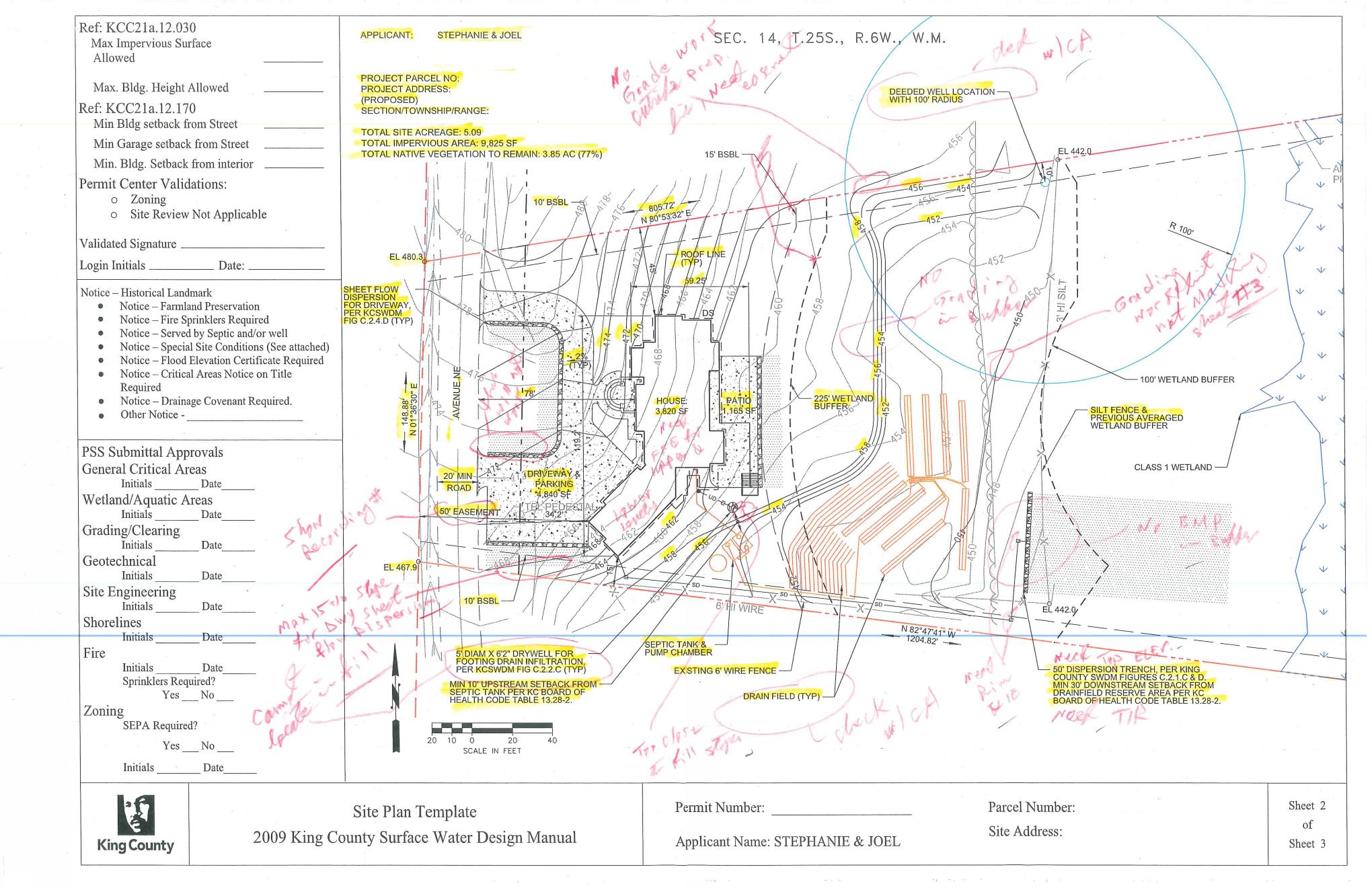
The County reviewers wanted us to move the drainage dispersion trench out of the wetland buffer.  This really doesn’t make sense to me since all of the water naturally drains to the area I located it in, but apparently it had to go in order to get our permit approval.  If I was going to relocate the drainage feature, I was going to change the type too.  I really didn’t want to have a soggy backyard, so I changed it to being a drywell.  In order to use a drywell system, you have to calculate the amount of roof runoff would be directed towards the drywell, and using the soil type you can appropriately size the drywell.  Here’s my calcs:

Drywell Sizing Calculations

Drywell Sizing Calculations

With the drywell sizes for both the driveway and for the roof runoff I was able to place them on the property in an area that’s outside of the wetland buffer and that was it!

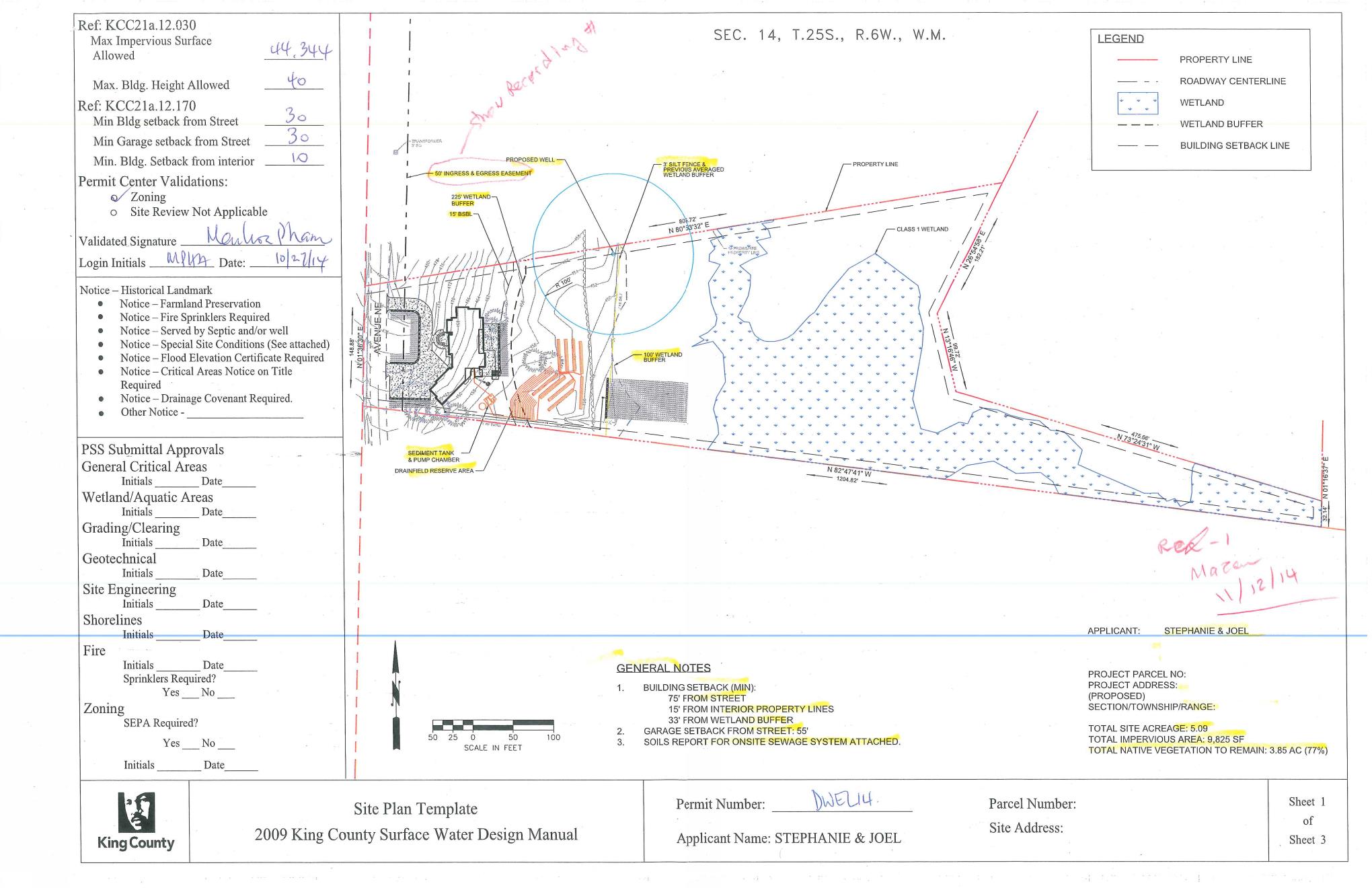
Final Site Plan - Sheet 1

Final Site Plan – Sheet 1

Final Site Plan - Sheet 2

Final Site Plan – Sheet 2

Final Site Plan - Sheet 3

Final Site Plan – Sheet 3

With the new site plan, I got a call from the reviewer and we passed – he was ready to approve our plans!  The last step to getting his final approval is to get our drainage BMP’s recorded with the county.  With that recording number he’ll sign off and we’ll be done with the Civil Review.

Building Permit – Civil Resubmittal

Immediately after getting our Critical Areas Approved, I called and scheduled my appointment for the resubmittal for our Civil Review.  Luckily I was able to get in a week later on the 30th at 10am.  I felt like I was going to battle this morning though – the reviewer we had was known for being one of the most difficult at the County – lucky us.  I basically wanted to get in and out and just get our approval.

Far from it though – this reviewer didn’t agree with the Critical Areas Reviewer and called her in there and she rescinded her approval!!  What the heck!  She told us that we can’t do the small amount of regrading that we wanted to do on our property within the previously cleared buffer area.  Apparently she didn’t notice the regrading before and it was only when our civil reviewer pointed it out to her that she saw it.  So in order to get the Critical Areas Approved (again) I needed to revise our grading limits.  That’s fine with me though – it really not that big of a deal to adjust the grading.  So our #1 issues of Critical Areas seems to be easy to get approved again.

And our #2 issue was the small vs. large drainage review requirement.  The reviewer came in guns-a-blazin’ on this issue and it wasn’t until a drainage reviewer came in that he agreed with me and that we met the small drainage review requirement.  Phew!

So with a few more small plan changes, we’ll be able to resubmit our site plan for approval.

Building Permit – Critical Area Review Approved

Today we heard from King County for on our permit submittal.  The Critical Area Reviewer emailed and let us know that our proposed site plan will require mitigation for work within the buffer area.  She said that our septic drainfield is within the buffer and will require wetland enhancements/buffer mitigation work to be able to put it there.  I explained the history of our property and how the property has a previously permitted clearing area.  Since that clearing, the buffer widths increased, and part of the area is now within the new buffer limits.  We kept our drainfield design to fit within that area though and it was our understanding that having in that area met King County’s requirements.  The Critical Areas Reviewer did some more research on our property and found the old clearing permit.  She agreed with us and our Critical Areas Review was APPROVED!  Score!

Now we can resubmit for our Civil Review…

Permit Approval - Critical Areas

All White Exterior Design

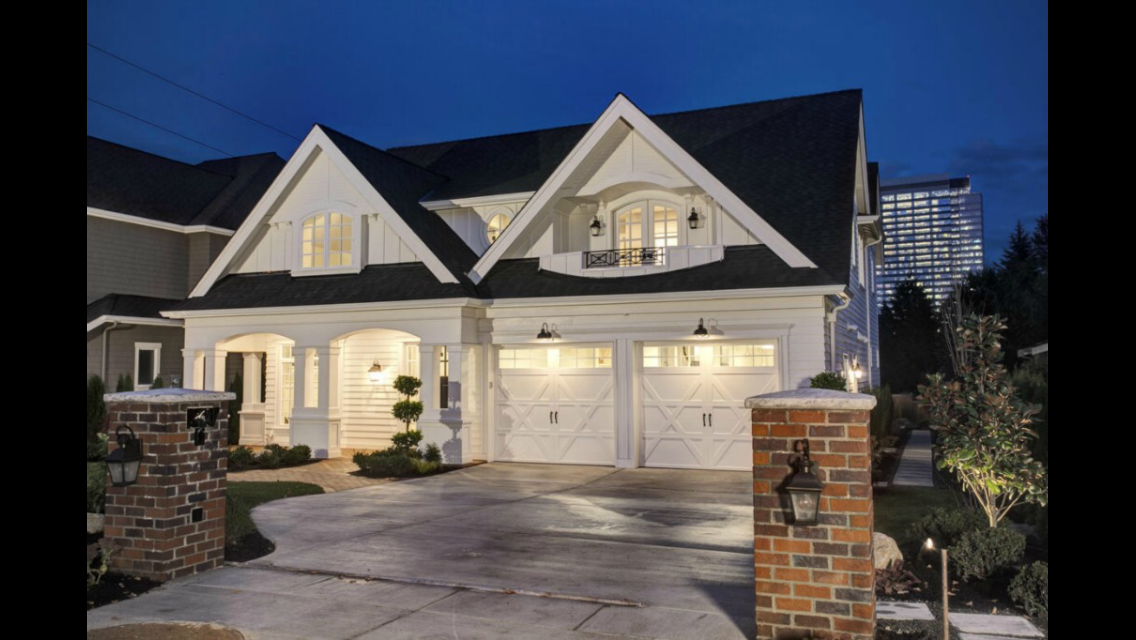
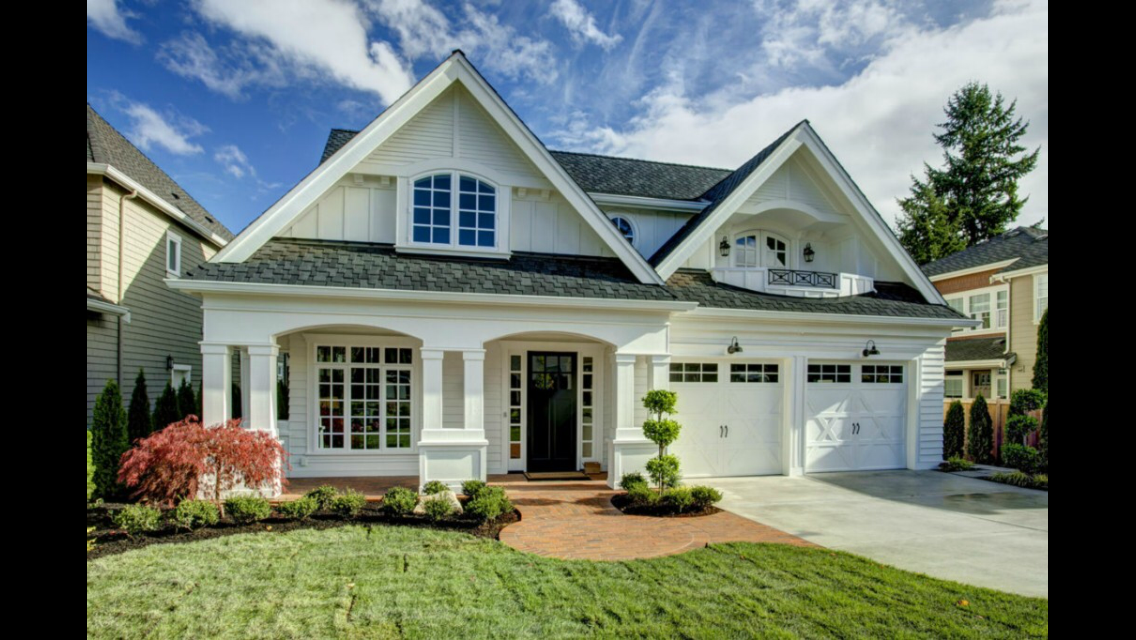
Last March our architect had the exterior of our house rendered, which included shingles and stonework.  Since then, we’ve completely changed our mind!  I’m so happy that we’ve had the time to think more about the exterior of our house and what we should do with it.  I recently saw this $2.1M brand new home in Bellevue online for sale, have driven by it a couple of times, and was completely inspired.  I showed one of our friends the pictures, she drove by the house too and she agreed that it was totally our style (even more so than our old rendering).

All white home in evening.

All white home in evening.

All white home during the day evening.

All white home during the day.

(via)

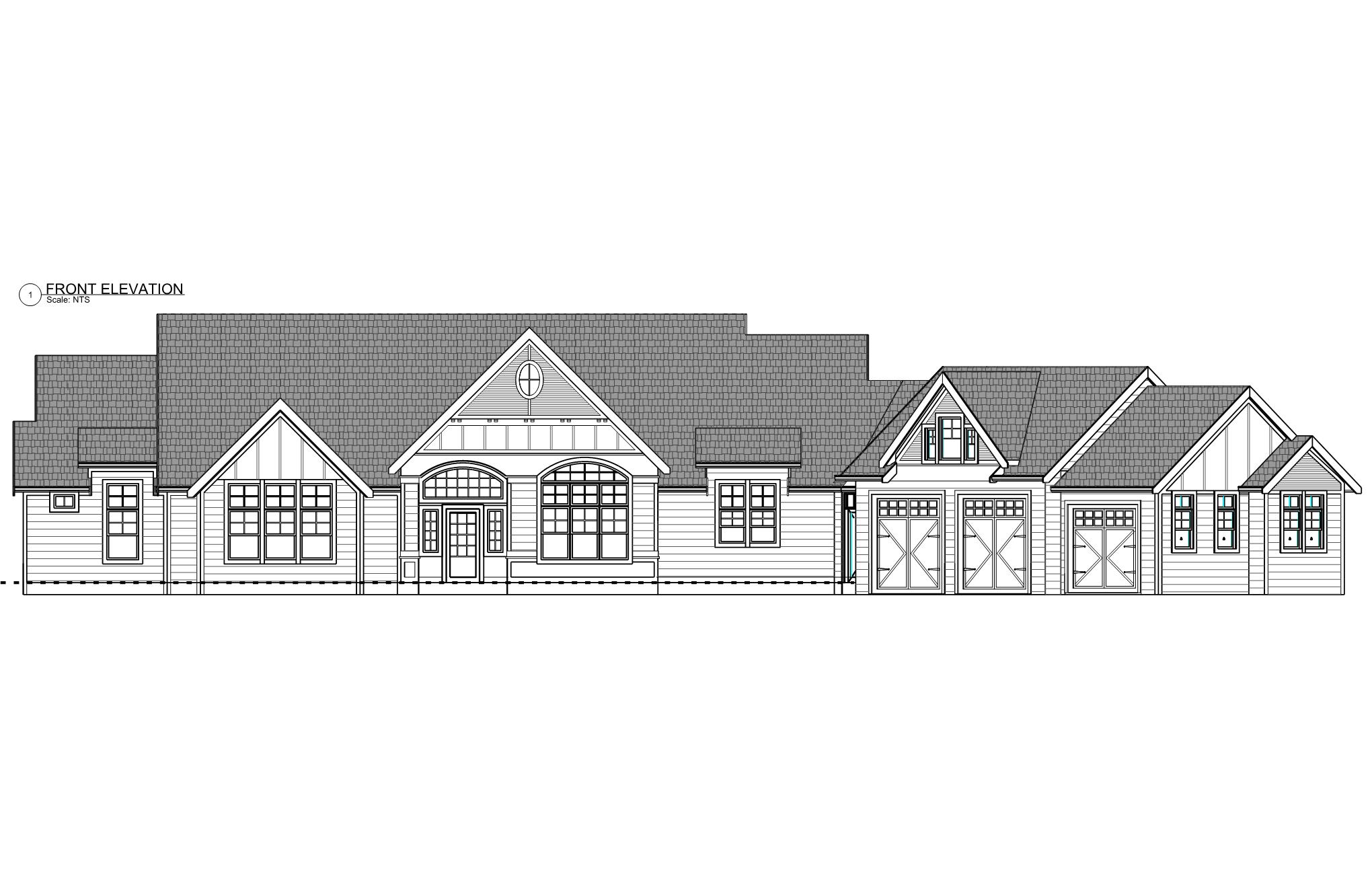
I love the coastal style and the crisp white exterior.  It’s definitely a lot more modern and current with clean lines but still maintains that classic Nantucket styling.  Joel and I both love it!  And of course I’ve been pinning all sorts of all-white houses on Pinterest to get more inspiration.  Here’s a quick idea of what our home would look like with the roof lines squared off, all white, and without the shingles.  Not sure yet if I’ll square off the top of the garage doors like I show, but I was just playing around to see what it would look like.

New sketch of our home without shingles & stonework.

New sketch of our home without shingles & stonework.

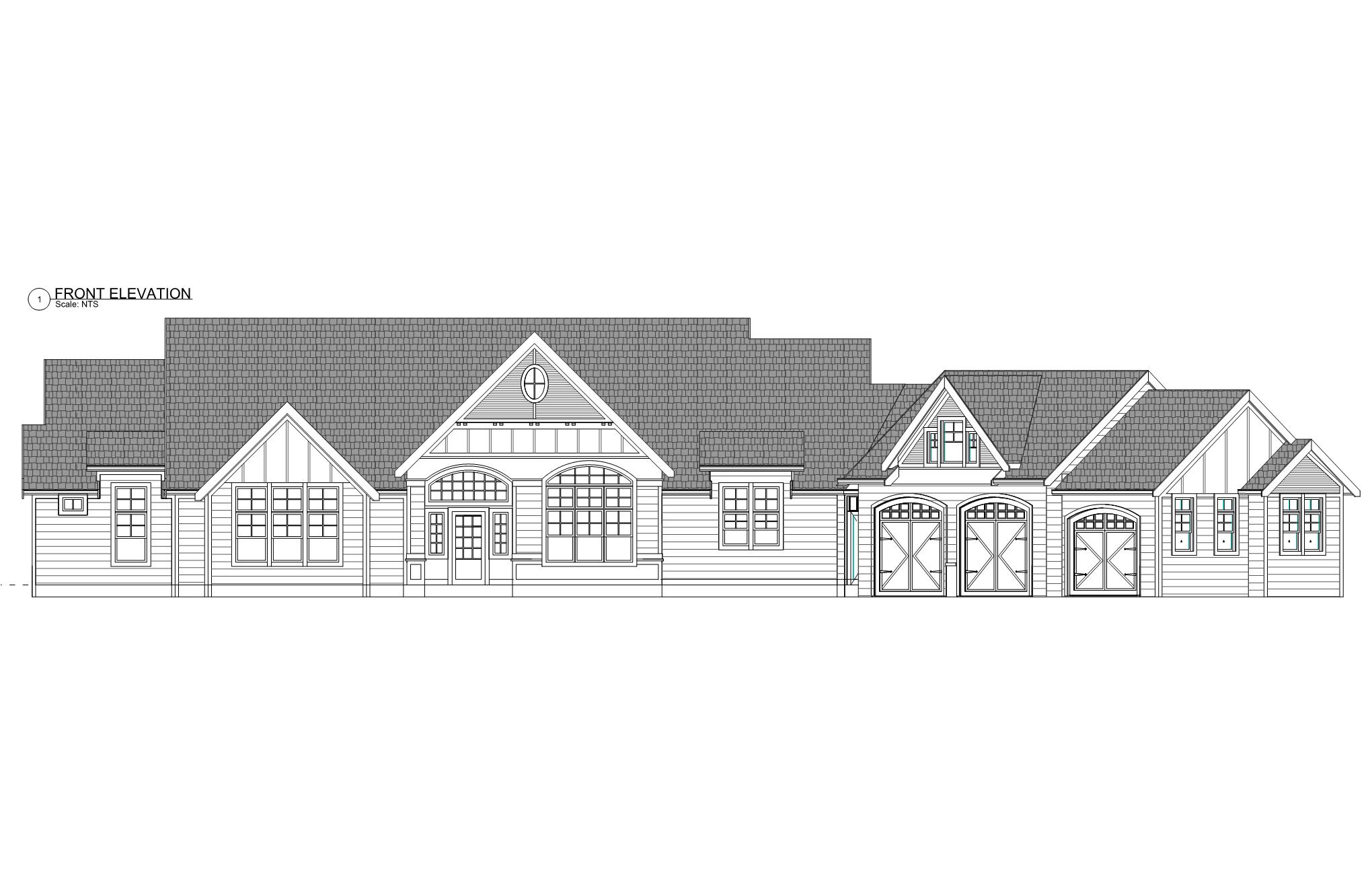
Here’s an updated sketch which shows what it would look like if the garage doors are arched…pretty sure I like this option better.  I think it ties in with the front entry and dining room window better than the first option.

Updated sketch to show arched garage doors.

Updated sketch to show arched garage doors.

Building Estimate Review Meeting #1

After work this evening we met with Matt Ruttan (our builder) to discuss our house estimate (finally)!  We’ve been waiting for a while for Matt to put together a true cost estimate to build our house.  To do this, Matt sent out copies of our plans (electronically) to different subcontractors that he would use to build our house.  In return, they sent him bids for what it would take to do the work.  He then compiled them in to what creates our estimate.  Although we could have done this any time, Matt thought it would be best for us to wait until when the subs are less busy which would give us better pricing (ie: when contractors are super busy they increase their price because their demand is so high).  Since we had the time to wait, Matt didn’t get bids until December which is typically a slower month for the construction industry.

Matt compiled our estimate and after adding in 95 different line items from all of the different subs we were over budget…by 25%!!  This was heart breaking!  The home of our dreams was completely unaffordable.

So, now the dirty work – why was it over budget, what made it so expensive, and how can we lower costs?  In my opinion, you need to ask a builder to put together a home bid in one of two ways:

  1. Bare bones. Have the builder tell you what’s the cheapest we can get this house built. Then if there’s extra room in the budget, you can ask the builder to add in more expensive things into the house.  Doing so, means that they either have to estimate how much those extras are going to cost, or the builder has to get new bids from his subs.
  2. Go for it. Tell the builder everything you could want in the house and then if the price is too expensive (as dreams usually are), the builder will take things out of the budget.

Luckily we chose Option #2 and had the builder go for it.  I say luckily because it gives us lots of areas that we can ‘cut’ from the home to be within our budget.  I had him do Option 2 because it still tells us how much those extras will cost us if/when we decide to put them in sometime in the future.  For example, we had him price out having a built-in buffet in the dining room. Obviously this is something we can live without and it doesn’t affect the overall quality of the home.  Although we’ll cut it now, it’ll be something we can add in later and now we know how much it will cost us!

Building Permit – Civil Review Comments

I just received comments via email from the Civil Review for our property.  For the most part, the comments are really ticky-tacky and minor.  For example, show elevations here, shift that over there, etc.  There were two things that were a bit difficult though 1) get Critical Areas Approval; and 2) perform a large drainage review.  #1 is a waiting game – the Critical Area Review is still in progress so we’ll just need to wait it out and see what the outcome is.  #2 is a big arguing point for me though – our site doesn’t require a full drainage review.  Our site meets criteria for a small drainage review since we have more than 65% of our lot in existing native vegetation protected by our Open Space Continuation covenant (we actually have 77%!).  The trick here is that you really need to read the Stormwater Manual to look for those “loopholes”.  On first blush, you’d think that our property would require a full drainage review – but when you really look into the Stormwater Manual criteria, you’ll see that it doesn’t.  Now I just need to prove it to the County!

The reviewer’s comments said that I needed to wait until we had full resolution on all of our items to be able to meet for the resubmittal.  So, we’ll need to wait until we have our Critical Areas Approval until I will be able to begin to prove my point about #2 (drainage review).

County Comments - Sheet 1

County Comments – Sheet 1

County Comments - Sheet 2

County Comments – Sheet 2

County Comments - Sheet 3

County Comments – Sheet 3

Building Permit Submittal

The last few weeks have been pretty busy with our home life (travel + work) so it took a bit for me to be able to get back to the County to turn in our building permit. Finally though, we resubmitted on Thursday, October 16th. I arrived right when they opened at 7:30 am. They called out the County’s surveyor to review the ingress & egress easements – we passed with flying colors (especially after I mentioned that a licensed surveyor found all of them for me). After that I turned in everything, paid our permit fee and I was on my way! Easy as pie this time!

The only catch – it’s a 4 MONTH review time. We likely won’t have an approved building permit until mid-February. So now it’s a waiting game.